Early Christians
Quo VadisThe Early Christians are portrayed as a worshipping community whose response to persecution unsettles Rome's assumptions about power. Their gatherings move from cautious assemblies and prayers for mercy to public testimony: even under threat, they meet, sing, and face death together. The community's endurance makes its faith visible to both persecutors and spectators, turning its treatment into a challenge to imperial authority.
Identity and Conditions
The Christians gather discreetly because they are exposed to suspicion and hostility. Vinicius observes their caution and wonders why they meet apart from the Jewish temples where offerings are made openly; Chilo explains that the Jews are their enemies and that the Christians also hide from a populace that accuses and hates them. Their concealment is therefore a practical response to danger, not evidence that they share the murderous intentions attributed to them.
The fire intensifies both the danger and the community's expectation of upheaval. After hearing the Apostle's words, Christians take heart and disperse to temporary dwellings, including places across the Tiber, as the flames cease advancing there. They regard Nero's rule as a satanic reign and anticipate its end as punishment for his crimes, while also reconsidering whether the end of the world and the day of judgment are immediate. Their hope joins immediate political expectation to a larger religious horizon.
Worship and Shared Faith
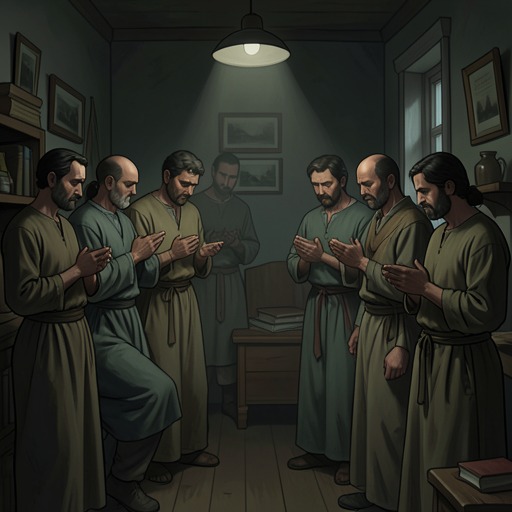
Under persecution, collective prayer gives form to fear without concealing it. At a meeting in a wine-shed, a small remnant kneels before a wooden cross and repeats, "Christ have mercy on us." The gathering includes people who have lost loved ones and heard reports of insults and torture in prison; their prayers express grief and doubt as well as hope. They ask why evil seems stronger than God, yet continue to look toward heaven and pray for deliverance.
Peter's recollection of Christ's death and resurrection answers that crisis through shared testimony. He tells the assembled Christians that he witnessed the crucifixion and initially cried out in anguish, then recalls that Christ rose on the third day. In this account, present suffering does not prove that faith has failed: the community's remembered foundation is a passage through death to renewed hope. Its prayer and Peter's words help the members endure without denying the gravity of what is happening to them.
Persecution and Public Witness
After the fire, popular anger gathers around the repeated cry, "To the lions with Christians!" The persecution becomes organized and widespread: the authorities prepare an enormous wooden amphitheatre and procure animals for the games, while crowds and guards hunt Christians through streets, ruins, cellars, and other hiding places. Some believers are seized as they meet openly; others are found in hiding. Their lack of resistance and their patience do not calm the persecutors, who misread those qualities as evidence of guilt and persistence in crime.
The Christians' conduct in the arena makes that misreading visible to the crowd. When condemned believers enter wearing animal skins, they kneel rather than plead for mercy. They begin singing "Christus regnat!" and continue with "Pro Christo!" Their posture and song show that they understand themselves as witnesses to a sovereignty beyond Nero: the spectators gradually recognize that the condemned are not asking for pity and appear not to attend to the Emperor or the audience. The episode turns a state spectacle into an occasion on which the persecuted community's faith becomes publicly legible.
Collective Power and Significance
The community's influence in the story lies not in military or political control but in its capacity to sustain shared belief under pressure. During the fire, public fear and rumor help fracture ordinary social bonds; during the persecution, the repeated demand for Christian victims channels that unsettled public feeling into violence. Against this collective rage, the Christians' gathering, prayer, and composed witness offer a contrasting form of solidarity. Their endurance does not immediately end their suffering, but it changes the meaning of the spectacle: Rome can command their punishment, yet their songs direct attention toward a ruler the Empire cannot make them renounce.